Stop Wasting Money on the Wrong Grout: The Ultimate Tile Grout Buying Guide for Wholesale & Commerci
If you've ever ordered a container of tile grout only to find it cracking within months, yellowing in humid environments, or failing chlorine resistance tests for pool projects — you already know how expensive the wrong grout choice can be.
This guide is written specifically for wholesale buyers, tile distributors, and commercial project managers who need to make the right call the first time. We'll break down every major grout type, compare performance across real-world scenarios, and help you match the right product to the right application — at scale.
What Is Tile Grout — And Why Does It Matter More Than You Think?
Tile grout is the material used to fill the joints between tiles after installation. It's not decorative filler — it's a structural and protective layer that determines how long a tile installation lasts, how easy it is to maintain, and whether moisture, mold, or chemicals can penetrate beneath the surface.
For commercial buyers, grout selection directly impacts:
Project longevity (fewer callbacks, lower warranty costs)
Maintenance burden (cleaning tile grout is one of the top complaints from end users)
Compliance (food-safe, VOC-free, and chemical-resistant requirements vary by application)
The market offers three primary categories: cement grout, epoxy grout, and polyurea grout. Each has a different chemistry, performance profile, and ideal use case.
How to Grout Tile: What Every Buyer Should Understand Before Sourcing
You don't need to be an installer to understand the process — but knowing how grout is applied helps you specify the right product format and avoid the most common sourcing mistakes.
The basic sequence: prepare the substrate → set the tile with adhesive → allow adhesive to cure → apply grout to joints → clean excess → allow grout to cure fully.
Key timing specifications that affect product selection:
Working time (pot life): How long the mixed grout remains workable. Epoxy grout has a shorter pot life than polyurea — critical for large-area commercial projects where installers need time to work. Always confirm with supplier before ordering at scale.
How long tile grout takes to dry: Walk-on time is typically 24 hours for cement and epoxy; polyurea can achieve walk-on in as little as 1–4 hours. Full cure (for heavy traffic or water exposure) is usually 72 hours. Faster cure = less downtime = lower project cost.
How long you can leave grout on tile: For epoxy grout especially, excess surface haze must be cleaned within the working window — typically 30–60 minutes depending on temperature. If left too long, tile grout haze forms a hard film that requires a dedicated haze remover to clean. This is a common pain point with epoxy; specify a product with a clear cleanup window and supply the appropriate tile grout haze remover as part of your kit.
Grout tile to wall (vertical application): Vertical surfaces require grout with appropriate viscosity to prevent slumping. Confirm the product is rated for both floor and wall use — not all formulas handle vertical joints equally.
The Core Comparison
1. Cement Grout — The Traditional Standard
Cement grout is the most widely used and lowest-cost option. Available in sanded (for joints over 3mm) and unsanded variants, and familiar to most installers. Tile grout with sand (sanded cement) suits wider joints; unsanded suits narrow mosaic joints.
Strengths:
Low material cost
Widely available; easy to source in bulk
Compatible with most tile types
Weaknesses:
Highly porous — absorbs water, stains, and bacteria
Requires a separate tile grout sealer after application (and resealing every 1–2 years)
Prone to cracking under thermal expansion or structural movement
Tile grout turns yellow over time in wet or UV-exposed environments — a major aesthetic liability
Not suitable for pools, food-prep areas, or chemical-exposure environments
Difficult to clean; tile and grout cleaning becomes a recurring maintenance cost
Verdict for commercial buyers: Suitable for dry, low-traffic, low-maintenance applications only. The lifecycle cost — cleaning, resealing, repair, and eventual replacement — consistently outweighs upfront savings.
2. Epoxy Grout — High Performance for Demanding Environments
Epoxy grout is a two-component system (resin + hardener) that cures into an extremely hard, chemically resistant surface. It's the go-to choice for pools, commercial kitchens, laboratories, and high-moisture environments.
Strengths:
100% waterproof — tile grout waterproof without any additional sealer
Excellent chemical resistance (chlorine, acids, cleaning agents)
Heat resistant — suitable for kitchen backsplashes and fireplace surrounds
Non-porous surface makes cleaning tile grout significantly easier
Available in a wide range of colors — tile grout gray, gold, green, white, and specialty finishes including glitter variants
No cement content — no efflorescence, no color fade
Weaknesses:
Higher material cost than cement grout
Shorter working time requires experienced installers
Risk of tile grout haze if surface isn't cleaned promptly — pair with haze remover
Less flexible than polyurea — not ideal for movement-prone substrates
Best applications:
Tile grout for swimming pools and wet rooms
Tile grout for commercial kitchen floors
Tile grout for shower walls and shower floors
Mosaic tile grout (with cartridge applicator for precision)
Any project requiring heat resistance or chemical exposure
3. Polyurea Grout — The Modern All-Rounder
Polyurea grout is the fastest-growing category and increasingly the preferred choice for buyers who need flexibility, speed, and safety without sacrificing durability.
Strengths:
Flexible — absorbs structural movement without cracking (essential for underfloor heating, LVT/vinyl tile, and exterior applications)
UV-resistant — does not fade or yellow outdoors
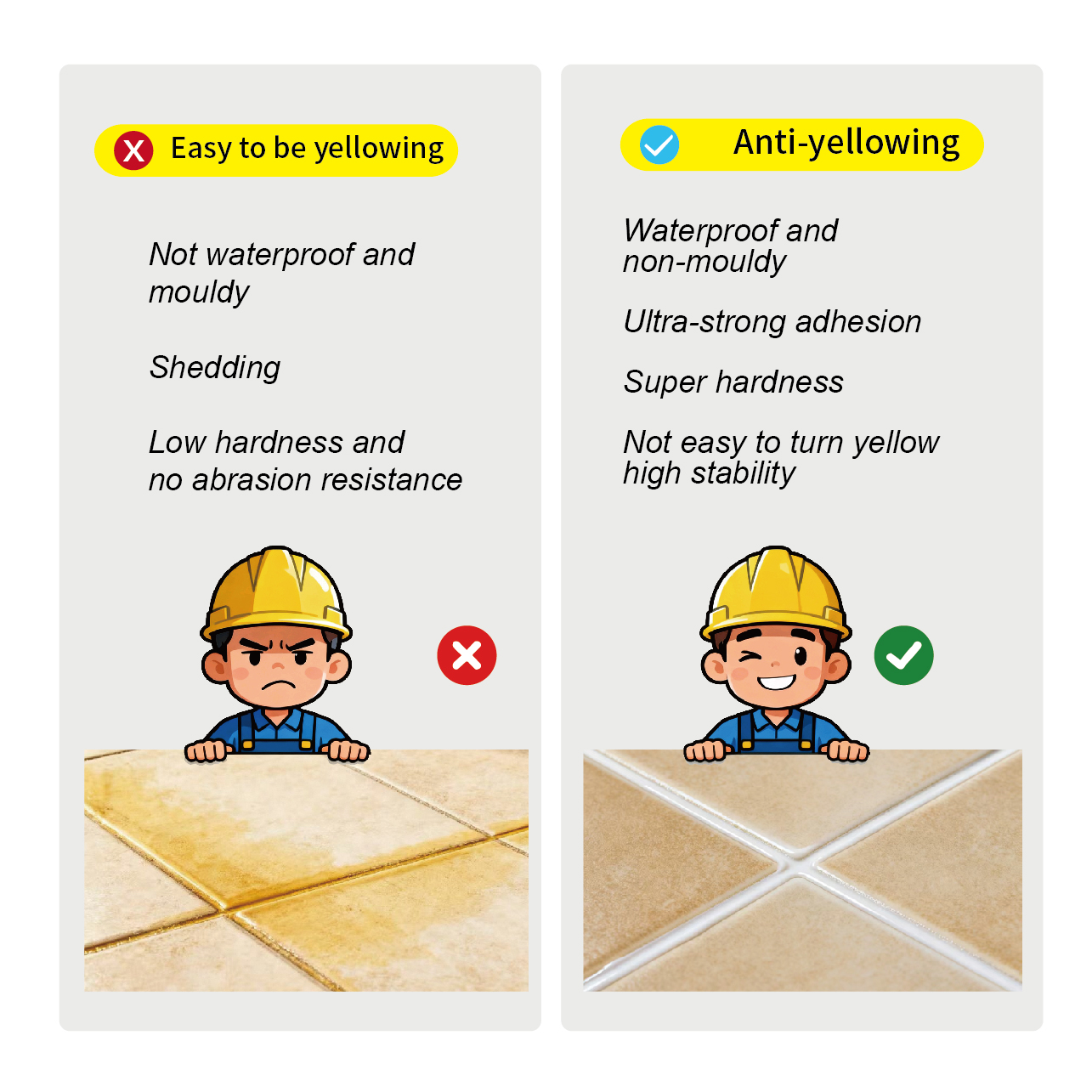
Anti-yellowing — the defining advantage for white tile grout. Tile grout turns yellow with cement; polyurea maintains color integrity long-term
Low-VOC, non-toxic — safe for food-contact areas, schools, and sensitive environments
Fast cure — walk-on in 1–4 hours; reduces project downtime significantly
Built-in sealer — tile grout with sealer in one formula, no additional sealing step
Compatible with grout for vinyl tile (LVT/LVP) and peel-and-stick tile formats
Compatible with
will tile grout stick to different substrates— polyurea adheres well to ceramic, porcelain, natural stone, and most rigid substrates (not recommended for wood, plastic, or silicone surfaces)
Best applications:
Tile grout for bathroom floor and wall
Tile grout for outdoor patios, facades, and balconies
White tile grout (anti-yellowing critical specification)
Grout for vinyl tile and floating floor formats
Mosaic tile grout where precision and color consistency matter
Projects with underfloor heating or thermal movement

Tile Grout Color Selection: More Than Aesthetics
Color choice is a sourcing decision, not just a design one. Key considerations for wholesale buyers:
Color matching by application:
Grout with white tile: White or light gray grout — specify anti-yellowing polyurea formula. White cement grout will yellow within 6–18 months in humid environments.
Black tile with black grout: Epoxy black delivers the most consistent color saturation without fading.
Tile grout gray: The most universally specified color — stock as core SKU.
Tile grout gold / green / glitter: Specialty decorative SKUs — high margin, low volume; suitable for boutique hotel and feature tile applications.
Tile grout paint vs proper colored grout: Some end users search for tile grout paint as a fix for discolored joints. This is a stopgap — painted grout peels and requires maintenance. The correct solution is tile grout color specified at installation with a quality pigmented formula. Use this as a content angle to educate your buyers and upsell proper product.
Tile Grout vs Mortar vs Adhesive vs White Cement: Clearing Up the Confusion
Grout is not adhesive. These are distinct layers:
Tile adhesive / mortar — bonds tile to substrate (goes underneath)
Tile grout — fills joints between tiles (goes on top, after tiles are set)
Tile grout vs white cement: In many markets, white cement is used as a low-cost substitute for proper grout — especially for mosaic and bathroom tile. The result: poor water resistance, significant yellowing, and rapid cracking. For buyers supplying construction companies or renovation contractors, this is a clear upgrade opportunity: tile grout vs white cement is a specification argument you can win on performance data alone.
Can tile grout be used as adhesive? No. Grout is engineered for joint-filling, not bonding. Using grout as adhesive leads to tile failure and project liability.
Will tile grout stick to wood, plastic, or silicone? No — grout requires a rigid, porous substrate. It should not be applied over wood subfloors (movement causes cracking), plastic surfaces, or existing silicone joints. These surfaces require removal and proper substrate preparation first.
What About "No Grout Tile" and Tile Flooring Without Grout?
Some buyers ask about tile without grout or tile flooring without grout — usually because they've seen rectified large-format tiles installed with near-zero joints, or they're trying to simplify installation.
The reality: even tight-joint installations (1mm or less) need some form of joint filler. Without it, moisture infiltrates beneath the tile, substrate movement causes edge chipping, and the installation fails faster. No grout tile aesthetics are achieved with narrow-joint epoxy or polyurea formulas — not by eliminating grout entirely. A good content strategy addresses this objection directly and recommends a fine-joint formula as the solution.
Tile Grout vs Tile Adhesive: Application Sequence Matters
A common complaint from first-time buyers: ordering grout but not understanding the installation sequence, leading to misuse or returns.
Correct sequence:
Prepare substrate — flat, clean, stable
Apply tile adhesive / mortar — bond tile to surface
Allow adhesive to cure (typically 24h)
Apply tile grout — fill joints
Clean excess — within working window (critical for epoxy)
Allow grout to cure — before water exposure or heavy traffic
Tile grout and adhesive kits (bundled) are an increasingly popular wholesale format — especially for the mosaic segment where buyers want a complete system. If you're building a product range, a tile grout and glue kit for mosaic is a strong SKU with clear differentiation.
Matching Grout to Application: Quick Reference for Buyers
| Application | First Choice | Alternative | Key Specifications |
|---|---|---|---|
| Swimming Pools | Polyurea | Epoxy | Chlorine-resistant, chemical-resistant, 100% waterproof |
| Shower Walls & Floors | Polyurea | Epoxy | Waterproof, mold-resistant, anti-yellowing |
| Bathroom Floors | Polyurea | — | Anti-slip, waterproof, fast cure |
| Outdoor Patios & Facades | Polyurea | — | UV-resistant, freeze-thaw resistant, flexible |
| Commercial Kitchen Floors | Polyurea | Epoxy | Heat-resistant, chemical-resistant, non-porous surface |
| White Subway Tile | Polyurea | — | Anti-yellowing — non-negotiable specification |
| Mosaic Tile | Polyurea | Epoxy | Fine-joint precision, color consistency |
| LVT / Vinyl Tile Floors | Polyurea | — | Flexible, low-VOC, floating-floor compatible |
| Underfloor Heating Systems | Polyurea | — | Elastic modulus handles thermal expansion |
| Exterior Facades & Walls | Polyurea | — | UV stability, freeze-thaw cycling resistance |
| Commercial & Industrial Floors | Polyurea | Epoxy | Heavy wear, chemical-resistant, easy to clean |
Why "Tile Grout in a Tube" Is the Format Wholesale Buyers Are Moving To
Traditional grout in powder bags requires on-site mixing — adding labor time, inconsistency risk, and waste. Tile grout in a tube (dual-component cartridge format) is now the preferred specification for professional installers:
Consistent mix ratio — no human error in batching
Tile grout premixed format — works directly with standard caulking gun
Reduced waste — apply exactly what's needed per joint
Better margin story — justifies premium positioning vs commodity bag grout
Tile grout 1kg price equivalent — cartridge format allows clear per-unit pricing that buyers can compare directly
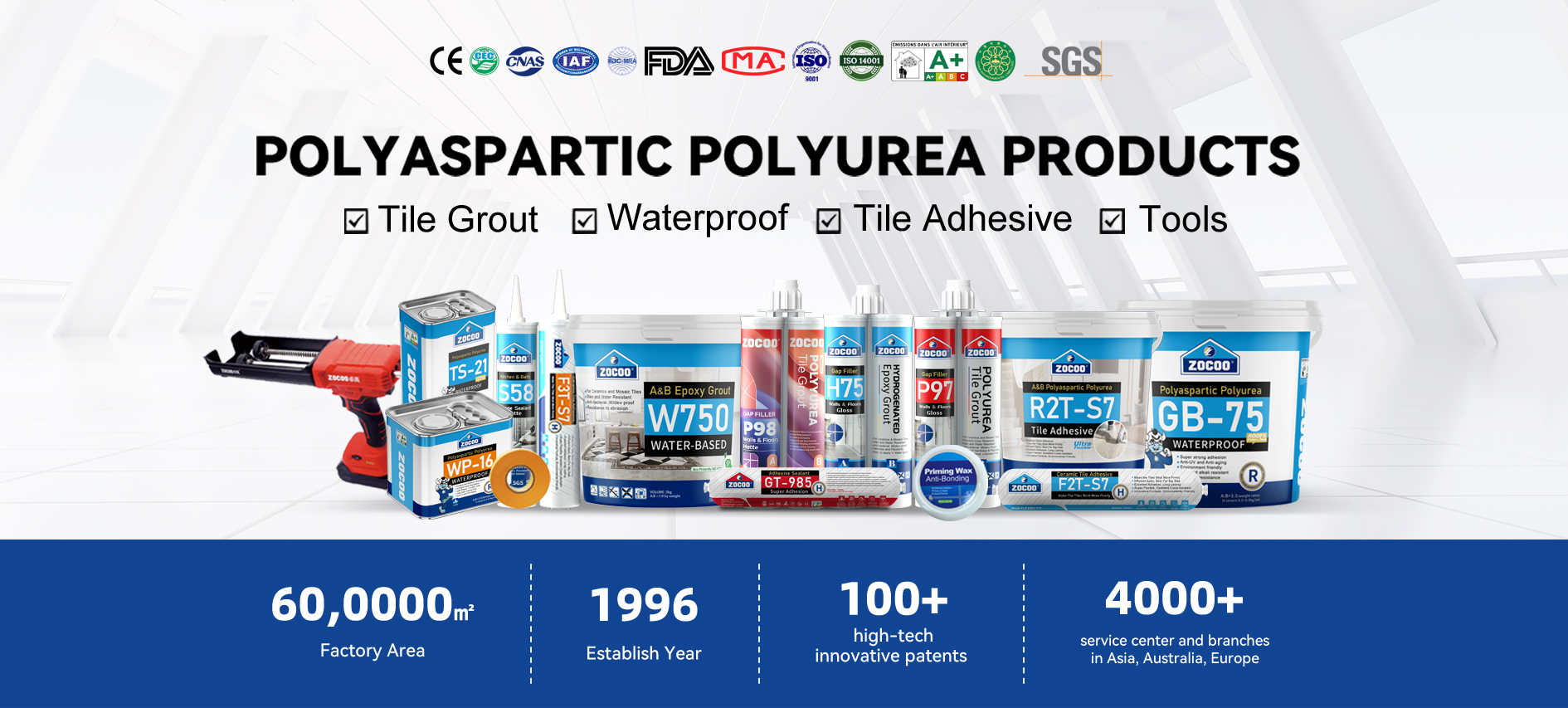
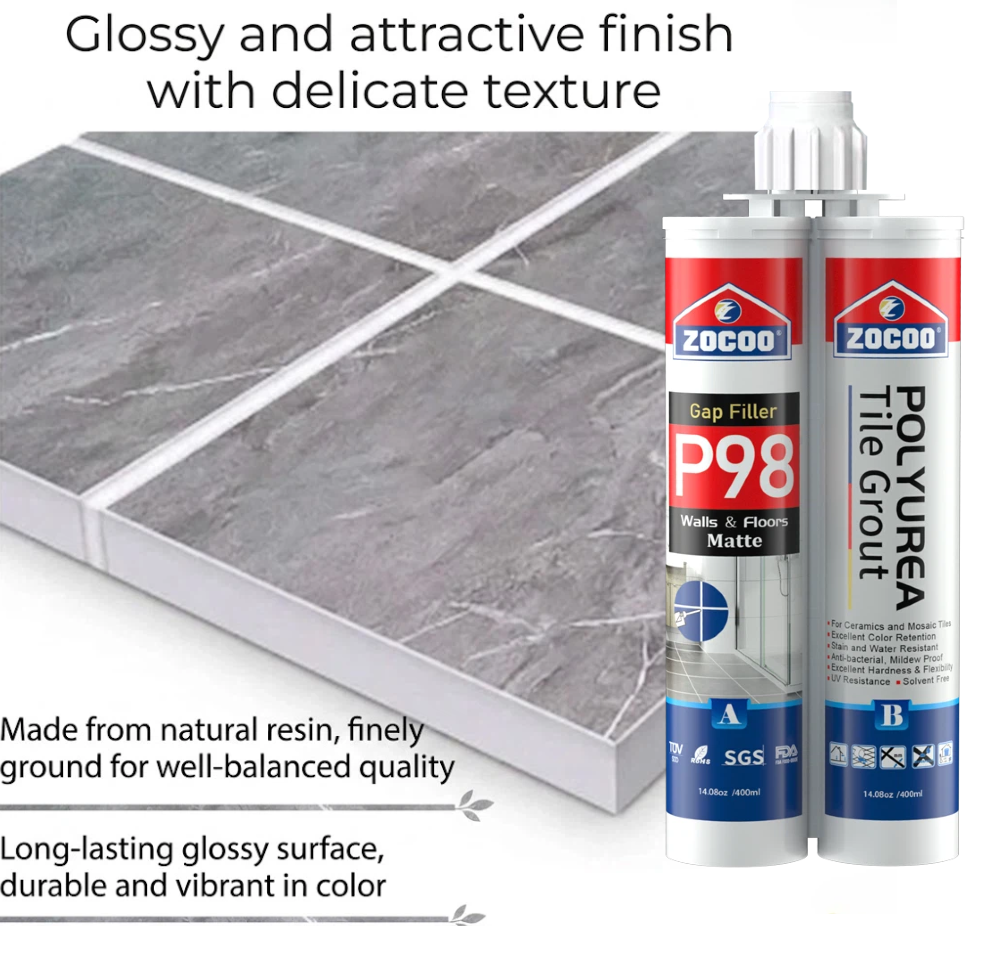
Zocoo's 400ml dual-component epoxy and polyurea cartridge is built for this market. Compatible with standard applicator guns, available across the full color matrix (gray, white, gold, green, and specialty), and designed for joints from 1mm mosaic to standard 5mm floor joints.
Commercial Tile Grout Cleaning: What B2B Buyers Need to Know
Commercial tile grout cleaning is a major operational concern for hotel chains, hospital facilities, and retail property managers — and it's directly affected by grout specification.
With cement grout, cleaning tile grout on floors requires:
Specialized tile grout cleaner solutions
Steam to clean tile grout (steam cleaning machines)
Mechanical scrubbers for heavily soiled joints
Periodic resealing after aggressive cleaning
With epoxy or polyurea, the non-porous surface resists staining at the chemistry level. Most soil wipes off with standard floor cleaning agents. Tile grout cleaner machine requirements are dramatically reduced — a concrete operational savings argument for facilities buyers.
Best tile grout cleaner recommendation: For cement grout maintenance, alkaline cleaners work for organic stains; acid-based cleaners for mineral deposits. For epoxy grout, pH-neutral cleaners preserve the surface. Always confirm steam-cleaning compatibility with the specific product before specifying for a facilities contract.
Tile grout vs vinegar and baking soda: DIY cleaning guides recommend these for cement grout. They work partially — but acidic vinegar degrades cement grout joints over time. Position professional cleaning products and high-performance grout as the long-term cost-efficient solution.
Why Tile Grout Cracks — And How to Prevent It at Specification Stage
Why tile grout is cracking is one of the most-searched pain points in this category. The causes:
Structural movement — building settlement, thermal expansion, vibration
Wrong product for joint width — sanded cement grout has joint width limits (3–12mm); unsanded for under 3mm
Insufficient cure time — loading tile before grout reaches full cure
Substrate deflection — uneven or moving substrate transfers stress to joints
Missing expansion joints — large tile fields need movement joints; grout cannot bridge them
The specification fix: For underfloor heating, exterior exposure, or large-format tile, specifying a flexible polyurea grout with appropriate elastic modulus eliminates cracking as a failure mode. This is a technical differentiator that professional contractors and developers respond to — and one of the strongest reasons to move buyers off cement grout.
Why You Should Always Seal Tile Grout — Or Specify a Self-Sealing Formula
Why seal tile grout? Cement grout is porous by nature — unsealed, it absorbs water, oils, cleaning chemicals, and biological matter. Sealing closes the surface pores and dramatically extends maintenance intervals.
When to seal tile grout: For cement grout, sealing should happen after full cure (minimum 72 hours, ideally 28 days for new installations). Resealing is recommended every 1–2 years depending on traffic and exposure.
The modern alternative: specify tile grout with built-in sealer — epoxy and polyurea formulas that are inherently non-porous and require no secondary sealing step. Tile grout and sealer in a single product eliminates a labor step, reduces project cost, and removes the risk of installers skipping the sealing step entirely (which they frequently do on budget projects).
Tile Grout Repair and Removal: What to Specify When Re-Grouting
For renovation and refurbishment projects, buyers often need tile grout repair products or tools for removing failed cement grout before re-grouting.
Tile grout remover tools (oscillating multi-tools with grout blades, or dedicated grout saw attachments) are standard accessories for re-grouting projects. Including these as part of a tile grout removal tool recommendation or kit bundle increases your average order value and positions you as a full-solution supplier.
After old grout removal, the sequence is the same as new installation — substrate prep, then new grout application. Epoxy or polyurea over an existing cement grout substrate is a direct upgrade with no compatibility issues on properly prepared surfaces.
What to Look for in a Wholesale Tile Grout Supplier
Technical specs to request:
Compressive strength (MPa)
Flexural / elastic modulus (especially for polyurea)
Chemical resistance chart (chlorine, acids, alkalis)
VOC content and safety certifications
Cure time: walk-on vs full cure
Working time / pot life
Joint width compatibility range
Coverage per unit
Certifications to verify:
CE marking (Europe)
REACH compliance
ISO 13007 tile grout classification
Low-VOC / LEED-compatible certification
Supplier capability checklist:
MOQ flexibility for trial and container orders
Private label / OEM capability
Color batch consistency across production runs
TDS, SDS, and installation documentation in target market languages
Technical support for specification and compliance questions
The Hidden Cost of Cheap Grout
| Cost Factor | Cement Grout | Epoxy / Polyurea |
|---|---|---|
| Material cost | Low | Medium–High |
| Sealer (required) | +15–20% | Not required |
| Cure / downtime cost | Standard | Lower (faster cure) |
| Cleaning labor (annual) | High | Low |
| Regrouting at 3–5 years | Likely | Unlikely |
| Total lifecycle cost | Higher | Lower |
For any project with a 3+ year horizon, advanced grout formulas win on lifecycle cost. This argument is especially powerful when selling to hotel developers, property managers, or commercial contractors who think in total cost of ownership — not unit price.
Final Checklist: Before You Place Your Wholesale Grout Order
Confirmed application environment (wet/dry, indoor/outdoor, pool/kitchen/bathroom)?
Know the joint width range for the project?
Heat resistance, chemical resistance, or flexibility required?
White grout specified? (→ anti-yellowing polyurea is non-negotiable)
Fast cure time needed? (→ polyurea; walk-on in 1–4 hours)
Sealer included in spec, or does the product need to be self-sealing?
Cartridge (tube) format or bag format required for the installer workflow?
Color confirmed with tile samples before bulk order?
TDS, SDS, and certification docs received from supplier?
Haze remover and cleaning accessories included in the project kit?
Getting grout specification right costs nothing. Getting it wrong at scale — on a 500-room hotel renovation or a commercial pool project — costs everything.
If you're evaluating wholesale grout suppliers or need technical documentation for a current project, contact Zocoo's trade team for samples, data sheets, and bulk pricing.