

Polyurea Tile Grout: The Ultimate Guide to Modern Wall & Floor Tiling Systems
In the evolving landscape of construction materials, the shift from porous cementitious fillers to advanced reactive resin systems is reshaping industry standards. As tile formats grow larger and installation environments become more demanding, traditional grouting solutions frequently face structural and aesthetic failures.
This guide provides a technical deep-dive into Polyurea Tile Grout—a high-performance, weather-resistant, and elastomeric system that addresses the critical limitations of cement and epoxy alternatives.
What Is Polyurea Tile Grout?
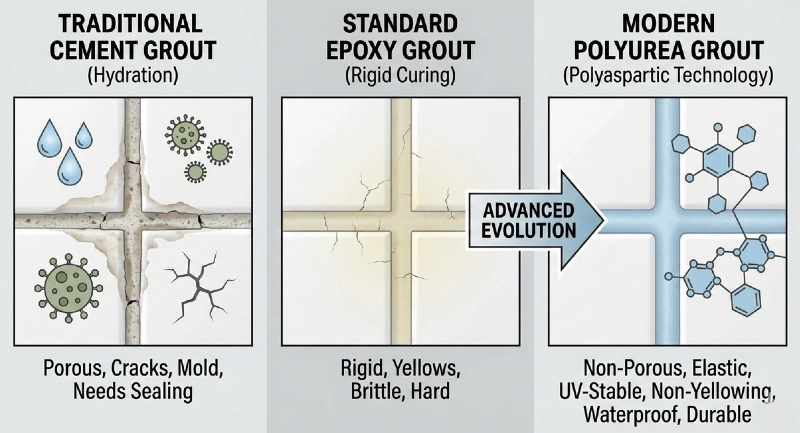
Polyurea tile grout represents the latest generation of reactive resin gap-filling materials. Unlike traditional single-component cement grouts that rely on hydration, or standard epoxies that rely on rigid chemical curing, polyurea is typically a two-component system based on polyaspartic ester polyurea technology.
Core Material Characteristics
At a molecular level, polyurea forms a dense, impermeable network through a rapid reaction between isocyanates and amine-terminated resins. This chemistry results in a material that combines the hardness of epoxy with the elasticity of rubber.
How It Differs
Vs. Cement: It is non-porous and does not require sealing.
Vs. Epoxy: It is UV-stable,non-yellowing,and possesses significant elongation properties,preventing the brittleness associated with traditional epoxy systems.
Common Tile Grout Problems in Real Projects
To understand the value of polyurea, one must first identify the recurring failures seen in residential and commercial tiling projects:
Cracking: Hairline fractures developing in grout lines due to thermal expansion/contraction or substrate movement.
Shrinkage: Grout sinking below the tile edge during the curing phase, creating hygiene traps.
Discoloration: White cement turning yellow or gray due to dirt absorption and oxidation.
Hollowing/Detachment: Loss of adhesion between the grout and the tile flank, leading to water infiltration.
Efflorescence: The migration of soluble salts to the surface of cement-based grouts, causing unsightly white deposits.
Why Traditional Grouts Fail
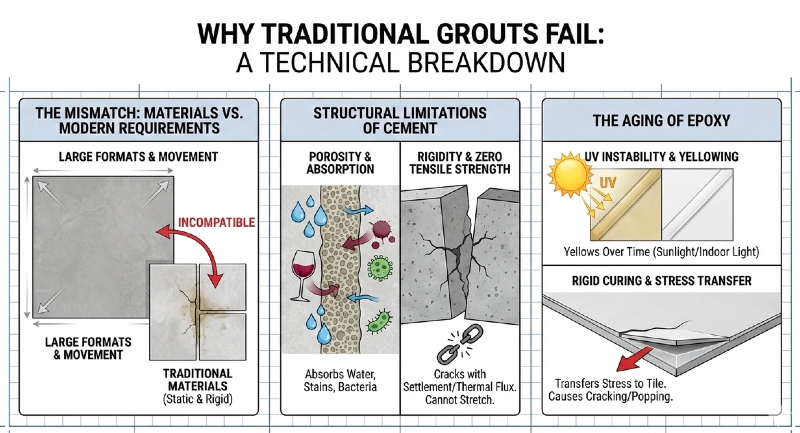
The failure of traditional materials is often a mismatch between material properties and modern construction requirements.
Structural Limitations of Cement
Cementitious grout is inherently porous and rigid. It absorbs water, stains, and bacteria. Furthermore, it has zero tensile strength; when a building settles or temperatures fluctuate, cement grout cracks because it cannot stretch.
The Aging of Epoxy
While epoxy offered a leap forward in stain resistance, standard epoxy grouts often suffer from UV instability. Exposed to sunlight (or even harsh indoor lighting), they yellow over time. Additionally, epoxy cures into a rigid plastic. In scenarios with large-format tiles—which expand and contract significantly—rigid epoxy can transfer stress to the tile, potentially causing the tile itself to crack or pop.
How Polyurea Technology Solves These Problems
Polyurea technology was originally developed for industrial waterproofing and heavy-duty floor coatings. Its adaptation for tile grouting introduces specific problem-solving mechanics:
Elastomeric Recovery: Polyurea can stretch and return to its original shape. This accommodates the coefficient of thermal expansion in tiles without cracking the joint.
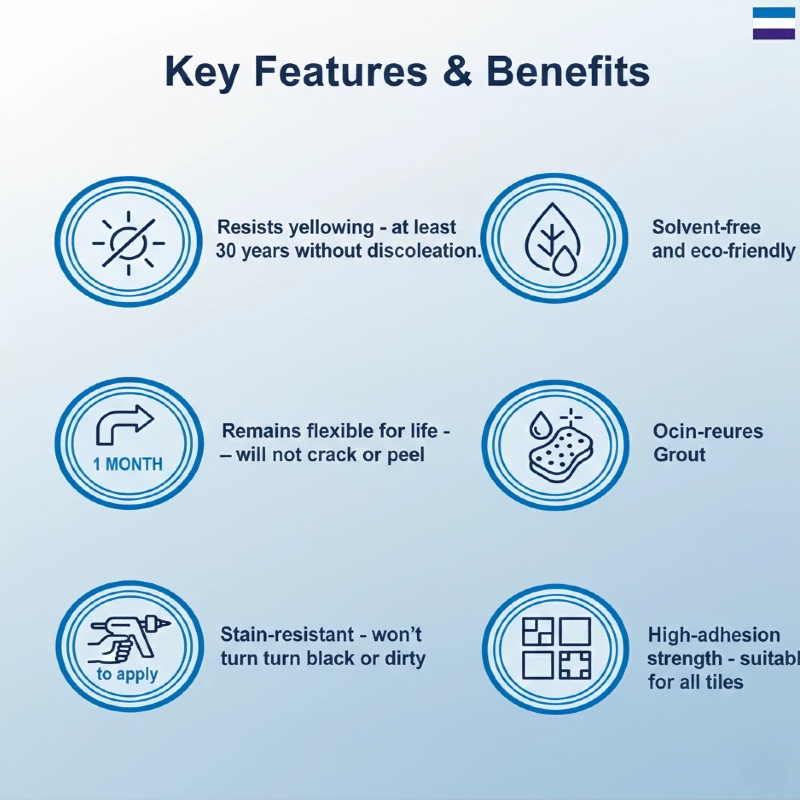
UV Stability: The aliphatic chemistry of high-quality polyurea prevents the molecular breakdown caused by UV radiation, maintaining color fidelity indefinitely.
Interface Bonding: Polyurea exhibits high surface energy, creating a chemical bond with ceramic, porcelain, and stone that far exceeds the mechanical bond of cement.
Fast Curing: Unlike cement (24+ours) or epoxy (12+ hours), many polyurea systems are touch-dry in hours, allowing for faster project turnaround.
Product Basics: Polyurea Tile Grout – Physical Properties
For engineers and specifiers, the physical parameters of polyurea grout dictate its suitability for high-stress environments. Below is an analysis of typical technical specifications and their real-world implications.
Technical Specifications & Interpretation
Density:
A high-density material ensures a non-porous, compact joint that resists water penetration and bacterial growth.
Hardness (Shore D):
This indicates a semi-rigid material. It is hard enough to resist scratching and traffic wear, but soft enough to absorb impact without shattering.
Bond Strength:
This creates a unified surface. The grout holds the tiles together with significant force, preventing "popping" or detachment in high-traffic zones.
Tensile Strength:
The material can withstand significant pulling forces (tension) without snapping, essential for buildings subject to vibration or settlement.
Elongation at Break:
This is the critical differentiator. The material can stretch up to of its length before breaking. This flexibility absorbs the thermal expansion of tiles that would crack rigid epoxy.
Yellowing Resistance:
No visible change under UV exposure. Crucial for white or light-colored grout lines in sunlit areas.
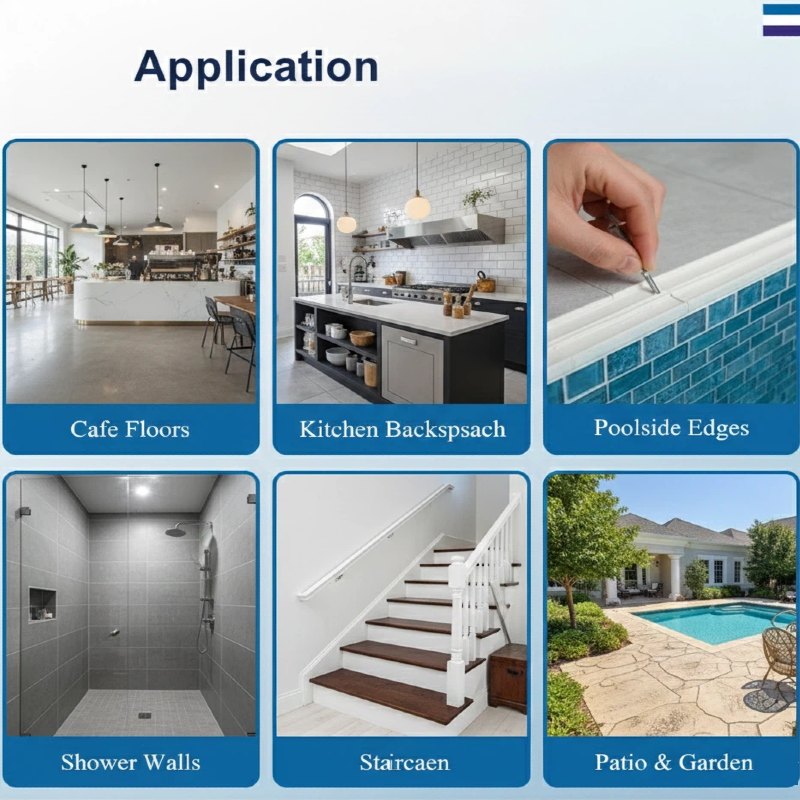
Typical Application Scenarios
Due to its versatile chemical structure, polyurea grout is suitable for diverse environments:
Residential Interiors: Living rooms, kitchens, and bathrooms where aesthetics and hygiene are paramount.
Commercial Spaces: Shopping malls, hotels, and office lobbies requiring high durability under foot traffic.
High-Traffic Areas: Airports and train stations where maintenance windows are short.
Large-Format Tile Projects: Slabs and large porcelain tiles requiring flexible joints to manage movement.
Exterior Environments: Balconies, facades, and swimming pool surrounds where UV and weather resistance are non-negotiable.
Why Polyurea Grout Is a Premium Solution for Modern Projects
For distributors and contractors, polyurea represents a shift from "commodity" products to "solution" products.
Engineering Reliability: It eliminates the callback costs associated with cracked or stained grout.
Long-Term Durability: While the initial material cost may be higher than cement, the lifecycle cost is significantly lower due to zero maintenance requirements (no sealing, no re-grouting).
Aesthetic Continuity: It enables the "seamless" look desired in modern architecture, where the rout joint visually disappears or perfectly complements the tile design.
Future Trends in Tile Grouting Technology
The construction chemicals industry is moving decisively toward Reactive Resin Systems. The era of mixing powder with water is fading for high-end applications.
The future belongs to materials that offer dynamic performance—materials that react to their environment rather than resisting it. Polyurea's ability to combine the durability of plastic with the flexibility of rubber positions it as the standard-bearer for the next decade of tiling technology, particularly as tiles continue to get larger and thinner.
FAQ
Is polyurea grout better than epoxy grout?
For most applications, yes. While both are durable, polyurea offers superior UV stability (it won't turn yellow) and higher flexibility. Epoxy is rigid and can crack under thermal stress, whereas polyurea can stretch to accommodate movement.
Is polyurea grout suitable for large-format tiles?
Absolutely. Large-format tiles expand and contract significantly with temperature changes. Polyurea's high elongation property allows it to absorb this movement, preventing the tiles from tents or the grout from cracking.
How long does polyurea grout last?
Polyurea grout is designed to last the lifetime of the tile installation. Its resistance to water, chemicals, and UV light means it does not degrade, powder, or erode like cementitious grouts.
Is polyurea grout environmentally friendly?
Yes. High-quality polyurea grouts are solvent-free and emit very low VOCs (Volatile Organic Compounds), making them safe for installers and homeowners. They contribute to a healthy indoor environment.
Is polyurea grout suitable for commercial projects?
Yes. Its high abrasion resistance and fast-curing properties make it ideal for commercial projects. Areas can often be reopened to foot traffic within 4 to 6 hours, minimizing downtime for businesses.


