Beyond Cement: Why Polyaspartic Polyurea is the Ultimate Solution for Large Format Tile Installation
Discover why traditional adhesives fail with big slabs. Learn how ZOCOO Flexible A&B Polyaspartic Polyurea Tile Adhesive provides high strength, crack resistance, and zero-hollowing results for modern construction projects.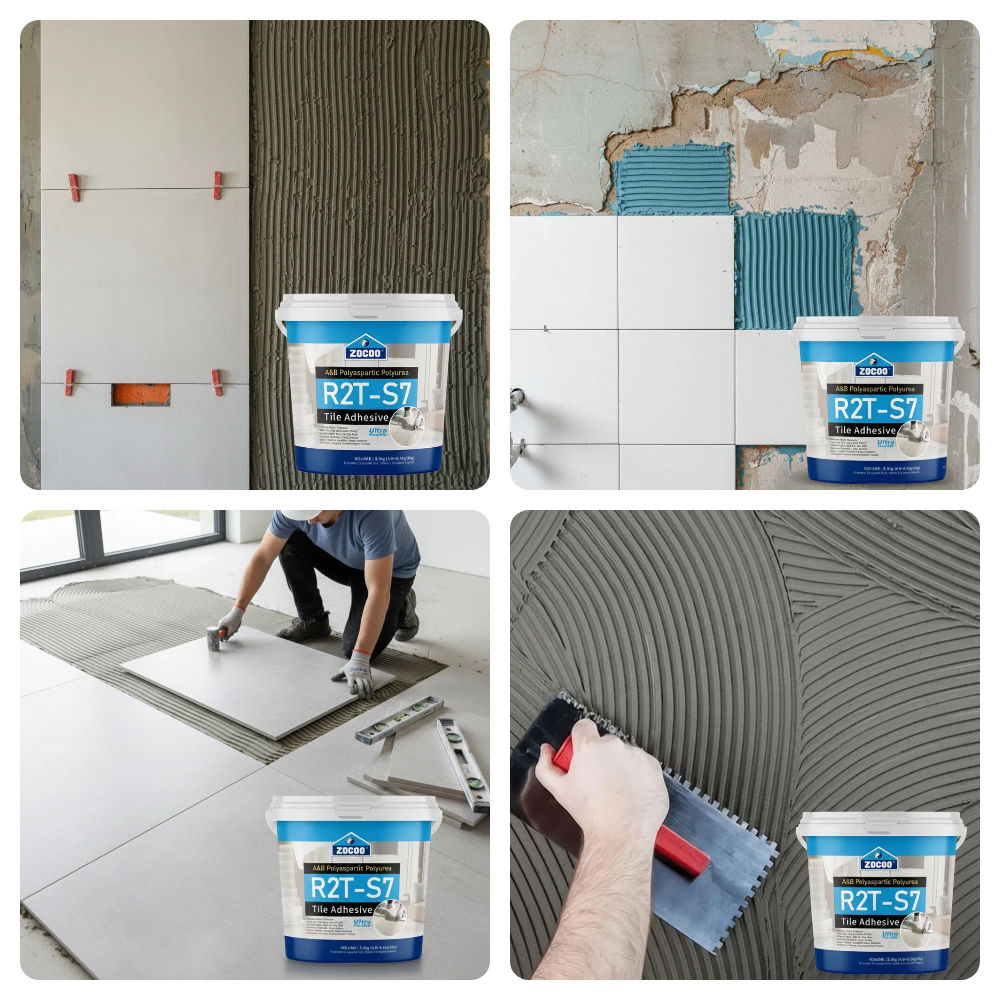
The Hidden Crisis in Modern Tiling: Hollowing and Detachment
In the world of modern construction, the trend is undeniable: tiles are getting larger, thinner, and denser. From massive porcelain slabs to sintered stone, the aesthetic is seamless and grand. However, this shift has exposed a critical weakness in traditional installation methods.
Contractors and project managers frequently encounter a nightmare scenario: tile hollowing, cracking, and eventual detachment.
The root cause is rarely the tile itself, but the bonding agent. Traditional cementitious mortars rely on mechanical interlocking—essentially gripping onto the pores of the material. But modern large-format tiles are engineered to have near-zero water absorption. With no pores to grip, cement struggles to hold on. When you add the stress of thermal expansion and contraction, rigid adhesives fracture, leading to costly repairs and safety hazards.
To solve this, the industry is turning toward advanced chemical bonding: specifically, reactive resin tile adhesive technology.
Why Traditional Mortar and Epoxy Fails on Big Slabs
Before introducing the solution, it is vital to understand the physics of failure in large-scale tiling.
The Rigidity Trap: Standard epoxy and cement are rigid. When a building settles or temperature changes cause the substrate (concrete) and the tile to expand at different rates, a rigid adhesive cannot absorb the stress. The result? The adhesive shears or the tile cracks.
Water Dependency: Cement requires water to cure and bond. With dense, big slab tile adhesive applications, the water has nowhere to escape, leading to weak curing and potential chemical staining on sensitive stones.
The industry needs a material that is both incredibly strong and surprisingly flexible. This is where polyurea tile adhesive technology enters the picture.
Enter ZOCOO: The Polyaspartic Polyurea Revolution
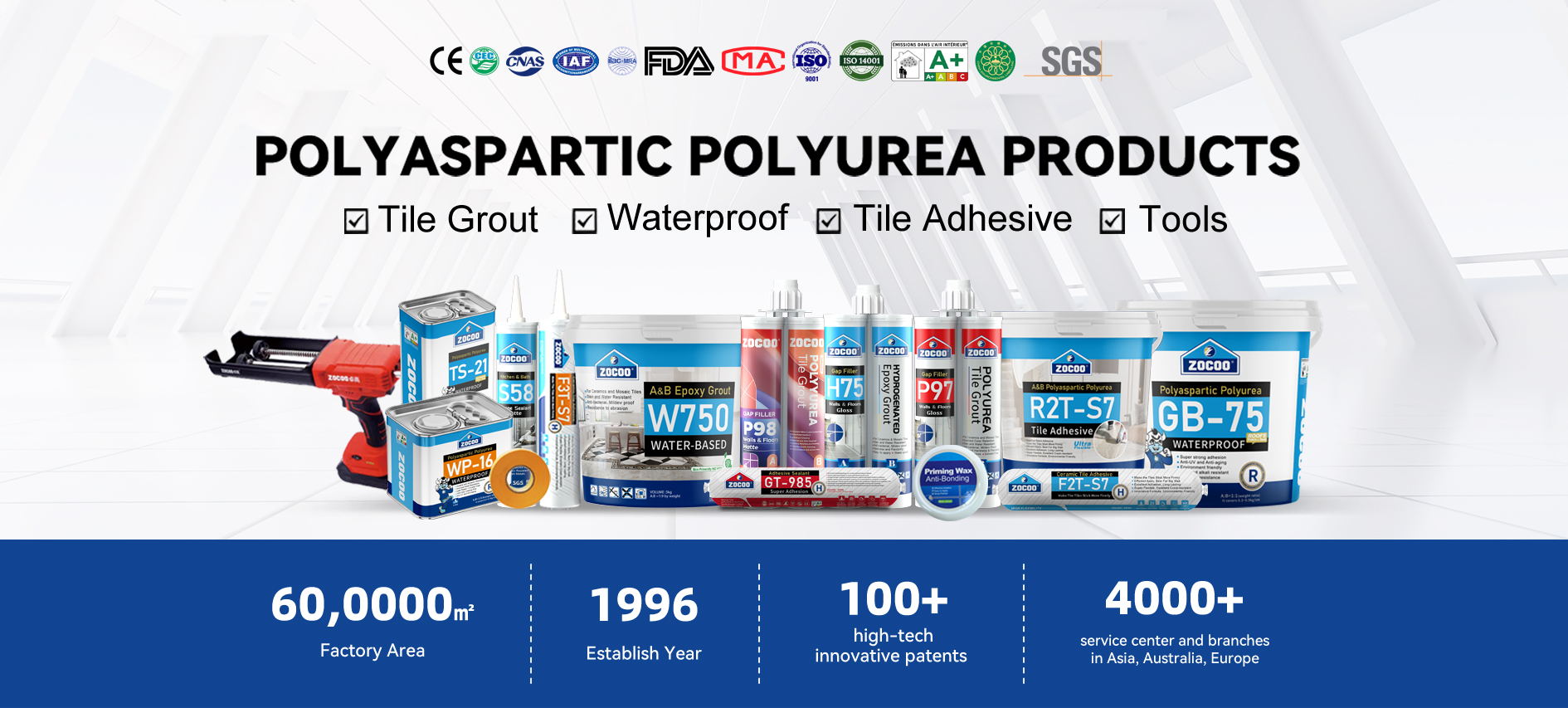
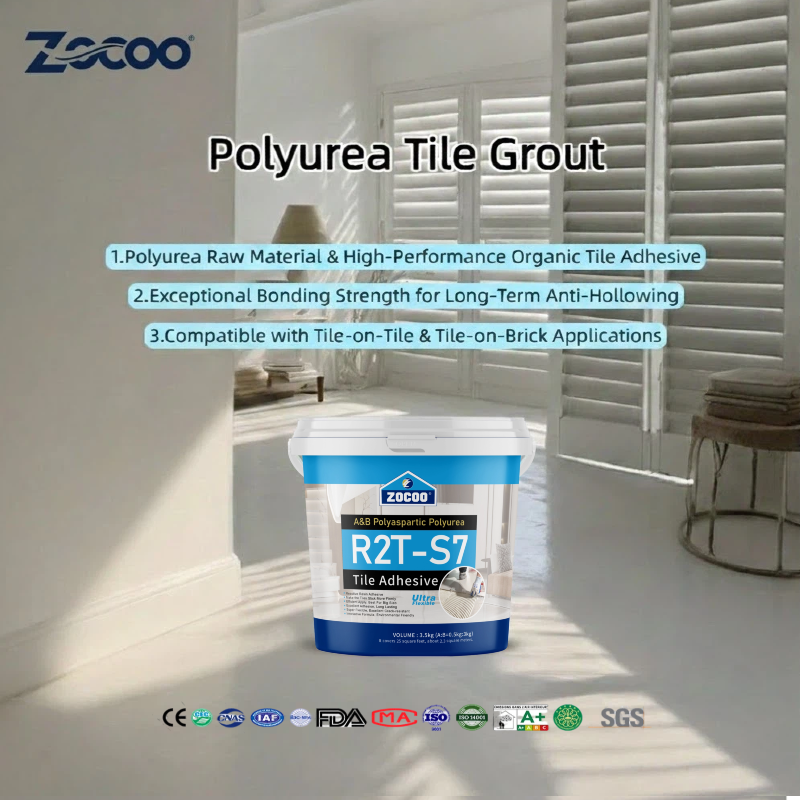
ZOCOO has engineered a next-generation bonding solution: the Flexible A&B Polyaspartic Polyurea Tile Adhesive.
Unlike traditional glues, this is a high strength tile adhesive based on polyaspartic polyurea chemistry—a technology originally developed for heavy-duty industrial coatings and waterproofing. By adapting this for ceramic and stone installation, ZOCOO offers a solution that chemically bonds to non-porous surfaces while maintaining the elasticity needed to survive structural movement.
Key Technical Advantages of ZOCOO Flexible A&B
1. The Power of "Flexible" Strength
The most defining feature of ZOCOO’s formula is that it is a flexible tile adhesive. It possesses a high elastic coefficient. Imagine the adhesive acting as a shock absorber between the wall and the heavy slab.
Vibration Resistance: Ideal for elevator interiors, subway stations, or high-traffic commercial floors.
Thermal Shock: It expands and contracts with the tile during temperature spikes, effectively making it a crack resistant tile adhesive.
2. Superior Chemical Bonding (Reactive Resin)
As a reactive resin tile adhesive, ZOCOO A&B does not rely on water absorption. It creates a covalent bond with the substrate and the tile backing. This ensures that even heavy, smooth-backed sintered stones stay permanently fixed vertically, without the risk of sliding or peeling over time.
3. Dual-Component Efficiency (A&B System)
The ZOCOO system utilizes a Part A and Part B mixture. This chemical reaction allows for:
Controlled Curing: Predictable setting times regardless of humidity.
Weather Resistance: Unlike cement which degrades with freeze-thaw cycles, polyurea remains stable in extreme environments.
4. Safety and Sustainability
Modern green building standards require materials that are safe for indoor air quality. ZOCOO is a non formaldehyde tile adhesive. It contains zero solvents and emits no harmful VOCs (Volatile Organic Compounds), making it safe for use in hospitals, luxury hotels, and residential homes.
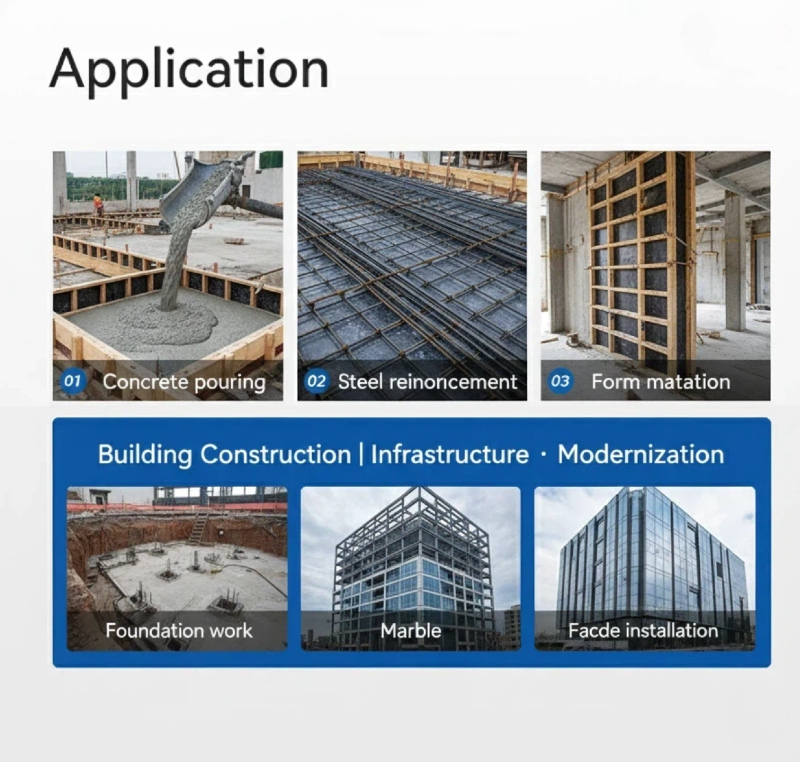
Ideal Applications for Large Format Projects
ZOCOO Polyaspartic Polyurea is specifically engineered for challenging installations where standard thin-set mortar is insufficient.
Large Format & Sintered Stone: The definitive large format tile adhesive for slabs exceeding 1200mm x 2400mm.
Vitrified Tiles & Glass Mosaic: Perfect for materials with zero porosity.
Metal & Wood Substrates: Can bond tile directly to difficult substrates that cement cannot adhere to.
Facade Cladding: withstands the thermal stress of exterior walls.
Conclusion: Future-Proofing Your Installation
The era of big slabs requires an evolution in adhesive technology. Continuing to use rigid, cement-based products on modern, non-porous tiles is a liability.
ZOCOO Flexible A&B Polyaspartic Polyurea Tile Adhesive represents the convergence of industrial durability and architectural finesse. By choosing a flexible, reactive resin system, distributors and contractors can guarantee installations that stand the test of time, preventing the costly headaches of hollowing and detachment.
Ready to upgrade your installation standards?Contact our technical team today to discuss how ZOCOO can support your next large-scale commercial or residential project.